How thick should a concrete slab be?
4 inches for patios, walkways and shed floors. 5 inches for a driveway carrying cars. 6 inches for RVs, heavy trucks and garage slabs with point loads. Below 4 inches you are pouring a path, not a slab.
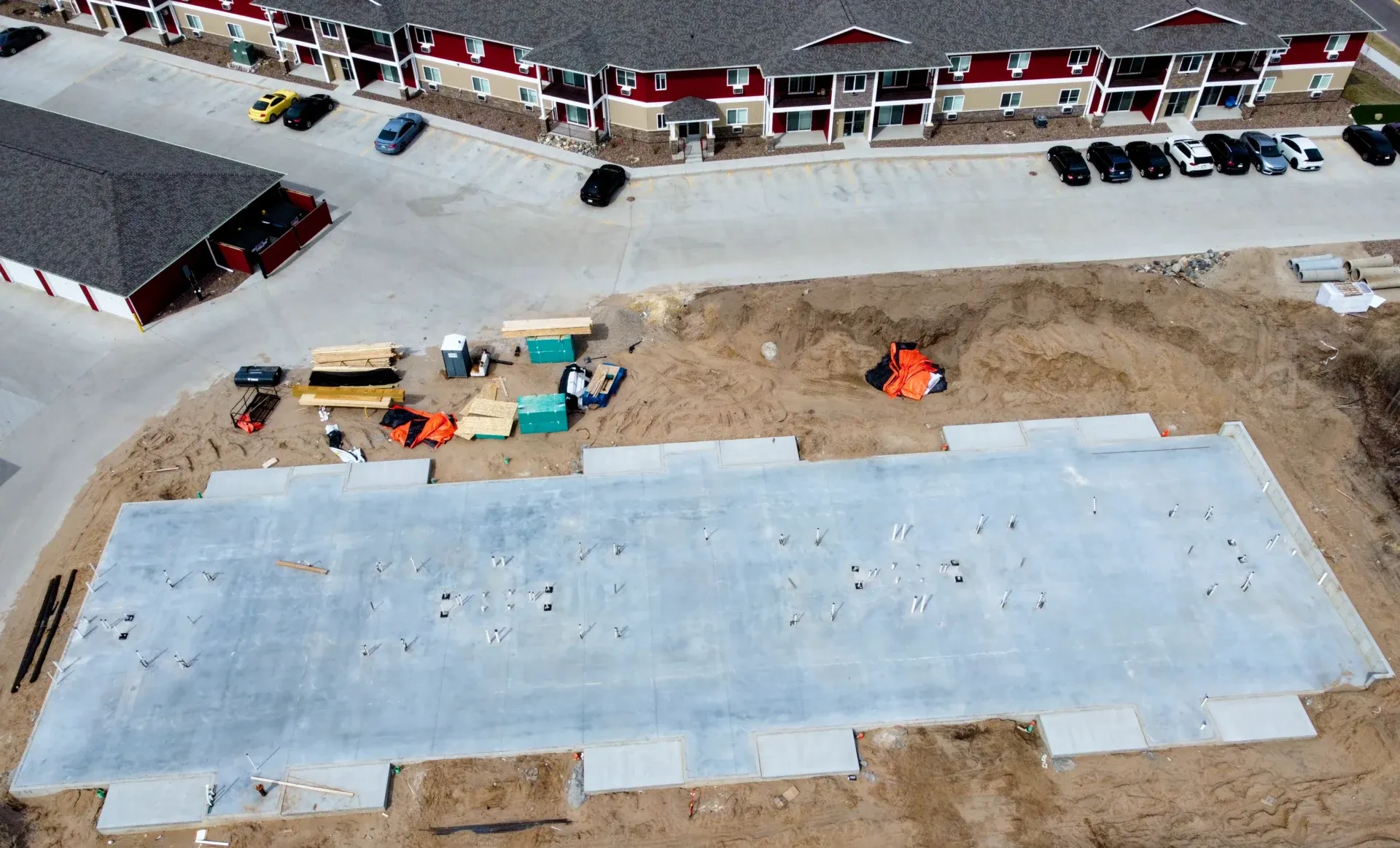
Thickness is the cheapest insurance in concrete and the most common place to cut corners, because nobody sees it once the slab is poured. A 3 inch slab can look perfect for two years and then crack through the middle the first time a loaded truck parks on it. The table below is the practical range used by residential contractors in the US.
Thickness by use
| Use | Minimum thickness | Reinforcement | Base |
|---|---|---|---|
| Garden path, stepping stones | 3 in | None | 2 in sand or gravel |
| Patio, walkway | 4 in | Mesh or fibre | 4 in compacted gravel |
| Shed floor, hot tub pad | 4 in | Mesh, thickened edges | 4 in gravel |
| Driveway, cars | 5 in | #3 rebar grid or mesh | 4–6 in gravel |
| Driveway, RV or heavy truck | 6 in | #4 rebar at 18 in centres | 6 in gravel |
| Garage slab | 4–5 in | Mesh plus 12 × 12 in edge beam | 4 in gravel + vapour barrier |
| Commercial / point-loaded | 6–8 in | Engineered | Engineered |
Why thickness matters more than strength
Concrete is strong in compression and weak in tension, and a slab on grade fails by bending rather than crushing. Doubling the thickness roughly quadruples the slab's resistance to bending, which is why an extra inch matters far more than an extra 500 psi of mix strength. A 4 inch 4,000 psi slab will outperform a 3 inch 5,000 psi slab every time.
For residential work, 4,000 psi mix at 4–6 inches is the standard combination. Higher strength is useful for exposed surfaces and freeze-thaw cycles, not as a substitute for depth.
What sits under the slab
- Subgrade. Strip topsoil and organic material. Anything that was once a plant will rot and leave a void.
- Gravel base. 4 inches of compacted crushed stone, placed in two lifts and compacted with a plate. This is the drainage layer and the level bed.
- Vapour barrier. 6 mil polyethylene under interior slabs and garages, lapped and taped. It stops ground moisture migrating through the slab and lifting floor coatings.
- Reinforcement. Mesh or rebar on chairs, positioned in the middle third of the slab — not lying on the gravel.
- Forms. Set to finished grade with a fall of about 1 inch per 10 ft away from the building for drainage.
A slab poured on dirt without a base is the single most common cause of residential concrete failure. The concrete is rarely the problem — the ground under it moves, and the slab cracks where it moves.
Control joints and where cracks go
Concrete shrinks as it cures and will crack. Control joints give it a planned place to do so. The rule of thumb is spacing of 2–3 times the thickness in feet:
| Thickness | Joint spacing | Joint depth |
|---|---|---|
| 3 in | 6–9 ft | 3/4 in |
| 4 in | 8–12 ft | 1 in |
| 5 in | 10–15 ft | 1 1/4 in |
| 6 in | 12–18 ft | 1 1/2 in |
Joints are cut with a saw once the concrete has set enough not to ravel — usually 6–12 hours after finishing, and before the slab gets cold. Formed joints using a groove tool achieve the same thing on smaller pours.
Cost of getting thickness wrong
Concrete is priced by volume, so thickness has a direct cost. Per square foot, each extra inch adds about $0.50–$0.75 in material and roughly $1–$1.75 installed, depending on access and finishing.
| Slab | 4 in | 5 in | 6 in |
|---|---|---|---|
| 100 sq ft — concrete volume | 1.23 cu yd | 1.54 cu yd | 1.85 cu yd |
| 100 sq ft — concrete cost | $185–$260 | $230–$325 | $280–$390 |
| 400 sq ft — concrete cost | $740–$1,040 | $920–$1,300 | $1,120–$1,560 |
On a 400 sq ft driveway, moving from 4 to 5 inches costs roughly $180–$260 in concrete. Replacing a cracked driveway costs $3,500–$8,000. The extra inch is not the expensive part.
When to ask for an engineer
- Anything carrying a vehicle heavier than a light truck on a regular basis.
- Slabs on fill, slopes or soil with a high clay content.
- Post-tensioned or suspended slabs — never a rule-of-thumb job.
- Slabs supporting structural walls or columns.
- Anything where the local building department requires a stamped drawing.
For everything else — patios, shed pads, driveways on stable ground — the thickness table above is the standard starting point. Use the concrete calculator to price the volume once you have picked a thickness.
Frequently asked questions
Is 4 inches thick enough for a concrete driveway?
Not for a driveway. Four inches is fine for patios, walkways and shed floors, but a driveway carrying cars and light trucks should be at least 5 inches, and 6 inches if it will see RVs, loaded trailers or heavy delivery vehicles. Thin driveways crack at the edges and along wheel paths.
Should I put rebar in a 4 inch slab?
Wire mesh or synthetic fibre is enough for a patio or shed floor. Rebar becomes worthwhile where the slab spans soft spots, carries vehicle loads or has a thickened edge. Rebar placed on the ground does nothing — it needs to sit in the middle third of the slab.
How far apart should control joints be?
Two to three times the slab thickness in feet. On a 4 inch slab that means joints every 8–12 ft; on a 5 inch slab every 10–15 ft. Joints should be cut or formed to about one quarter of the slab depth, usually within 6–12 hours of finishing.
Does a thicker slab cost much more?
Concrete volume rises linearly with thickness: going from 4 to 5 inches adds 25% to the concrete cost, roughly $0.50–$0.75 per square foot in material and $1–$1.75 installed. On a 400 sq ft driveway that is $400–$700, which is cheap compared with replacing a failed slab.
Why did my 4 inch slab crack?
Usually one of four reasons: no control joints, a base that was not compacted, concrete that was mixed too wet, or a slab placed directly on organic soil. Cracking is normal; cracking in random places instead of at the joints is a detail failure.